ES

How you learn

Nobody rushes you. The eight hours never expire and you book them when you want.

You will fall in. A lot, the first day.

Windsurf

A board and a sail. You sail it standing up.

  • Getting the rig up and sailing off Three moments seen from above, wind falling from the top of the drawing. First the rig floats downwind of the board while you stand on the windward side, back to the wind, hauling on the uphaul. Then the rig is upright — from above the mast is only a dot — and the sail hangs loose, streaming downwind. Finally you sheet in and move off across the wind. The board lies across the wind in all three. wind Getting the rig upthe board stays across the windrig in the waterup, sail looseoff across the wind

    Standing up and moving

    Ten or fifteen minutes of theory, then into the water. Pull the sail up, get moving, step off, come back.

  • There and back Seen from above, wind falling from the top and running parallel to the beach on the left. You sail out on a beam reach, square to the wind; at the far end you turn and come back on the opposite beam reach. The sail is to leeward on both legs, which is what makes the same angle work out and back. wind There and backthe same beach, both beam reachesout across the windback across the windyou turn here:jibe or tackshore
    Jibe Seen from above, wind falling from the top. You come in on a beam reach, bear away, and the turn takes you through downwind: at the far end of the track you are running, sail all the way out, and the wind crosses behind the board. You come out on the opposite beam reach with the sail on the other side, having kept your speed. wind Jibethe stern crosses the windthe sail swaps sideshere the stern passesthrough the windyou keep your speed

    There and back

    Sailing in a straight line, and your first turn: the jibe.

  • Tack Seen from above, wind falling from the top. You are sailing close-hauled, forty-five degrees off the wind; the turn carries the bow through the wind — for that instant the board points straight at it, the sail flaps and you lose speed — and you come out close-hauled on the other tack, further upwind than you went in. wind Tackthe bow crosses the windthe bow pointsinto the wind: thesail flaps and youlose speedupwindupwind

    Turning both ways

    The tack is added. You no longer depend on a single manoeuvre to get back.

  • Sailing upwind Seen from above, wind falling from the top. The hatched wedge is the sector you cannot sail into: ninety degrees, forty-five either side of the wind. To reach the point directly upwind you sail close-hauled on one tack, tack, and carry on close-hauled on the other. The straight line is crossed out because it does not exist. wind Upwindyou cannot sail straight at the windyou can't sailin here45°a tack herewhere you want to be

    Reading the wind

    Upwind. This is where you start actually sailing, not just moving.

  • Every point of sail A points-of-sail rose seen from above, wind falling from the top. In the middle, the ninety-degree wedge you cannot sail into. Forty-five degrees either side, close-hauled with the sail sheeted almost to the centreline; at ninety degrees, a beam reach with the sail half out; and at the bottom, running with the sail all the way out. The same drawing explains why a tack crosses the wedge and a jibe avoids it. wind Every point of sailthe angle to the wind decides everythingno-goupwindupwindacrossacrossdownwind

    Every point of sail

    Upwind, downwind, tack and jibe. The full range.

  • On your own

    Sailing independently: more distance, less instructor alongside.
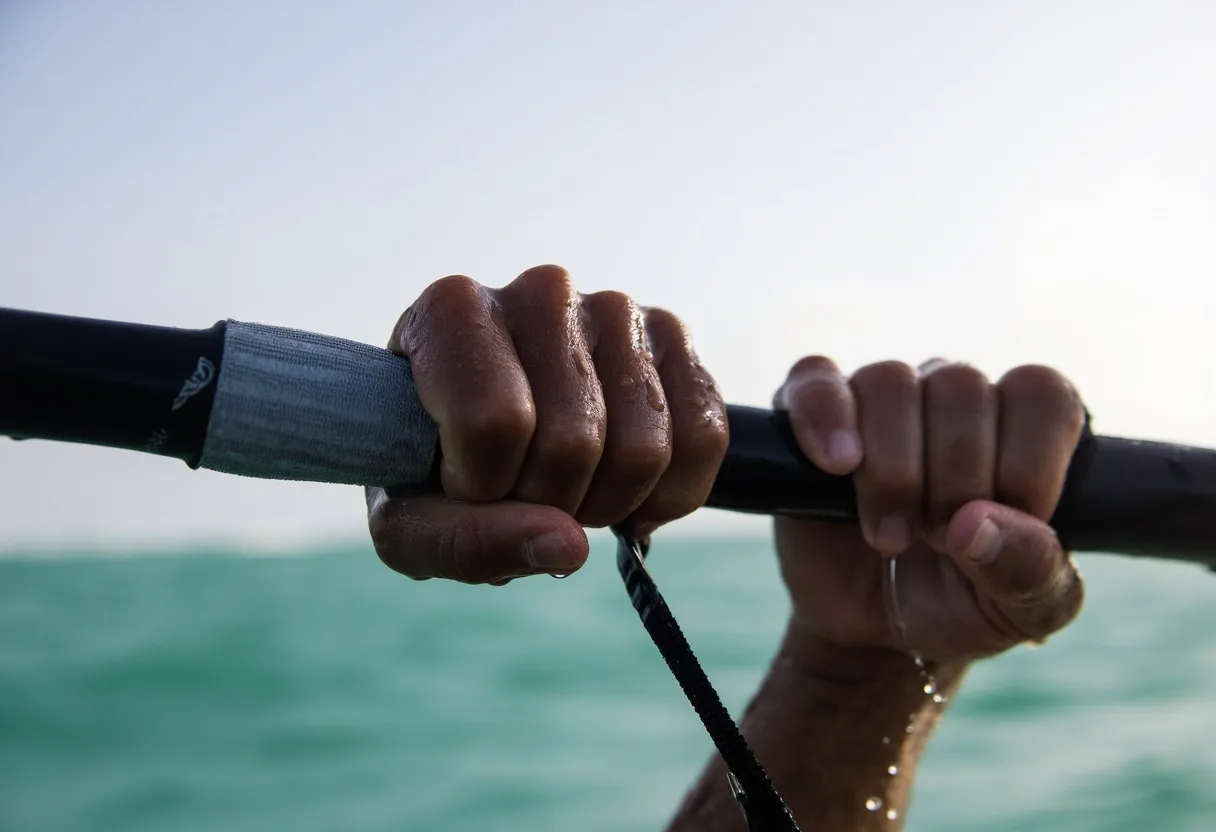
Close-up of two wet hands gripping a windsurf board's boom, with grip tape and water droplets.
The boom: the bar you hold on to. That is where the first day shows up.

Hobie Wave

A small sailing catamaran. You sit down — and you capsize it and right it on purpose.

  • Tack Seen from above, wind falling from the top. You are sailing close-hauled, forty-five degrees off the wind; the turn carries the bow through the wind — for that instant the board points straight at it, the sail flaps and you lose speed — and you come out close-hauled on the other tack, further upwind than you went in. wind Tackthe bow crosses the windthe bow pointsinto the wind: thesail flaps and youlose speedupwindupwind

    Theory and your first turn

    Fundamentals and the tack.

  • Jibe Seen from above, wind falling from the top. You come in on a beam reach, bear away, and the turn takes you through downwind: at the far end of the track you are running, sail all the way out, and the wind crosses behind the board. You come out on the opposite beam reach with the sail on the other side, having kept your speed. wind Jibethe stern crosses the windthe sail swaps sideshere the stern passesthrough the windyou keep your speed

    Turning both ways

    Tack and jibe.

  • Every point of sail A points-of-sail rose seen from above, wind falling from the top. In the middle, the ninety-degree wedge you cannot sail into. Forty-five degrees either side, close-hauled with the sail sheeted almost to the centreline; at ninety degrees, a beam reach with the sail half out; and at the bottom, running with the sail all the way out. The same drawing explains why a tack crosses the wedge and a jibe avoids it. wind Every point of sailthe angle to the wind decides everythingno-goupwindupwindacrossacrossdownwind
    Sailing downwind Seen from above, wind falling from the top and pushing from behind the board, which is running straight downwind. The sail is all the way out, almost square to the board, because the wind is no longer flowing across it: it is pushing. The dotted arc is a reminder that from there the sail can swing across on its own. wind Downwindthe wind behind youthe sail is all theway outand it can swingacross on its own

    Every point of sail

    Upwind and downwind.

  • Rescue Seen from above, wind falling from the top. Someone is in the water: you bear away, sail off, jibe, and come back close-hauled until you are directly downwind of them. The last few metres are made head to wind, because that way the boat stops of its own accord and never drifts down onto the person. wind Rescueyou always come from downwindsomeone overboardyou sail offjibehead to wind:the boat stopsyou come backclose-hauled

    Rescue

    Objects and people in the water. You learn how to get someone out.

  • Capsize and righting A capsized Hobie Wave, seen twice from astern. On the left, flat on its side: one hull in the water, the other above it, the trampoline between them and the mast resting on the surface, held there by the float at its head — which is what stops the boat turning right over. On the right, coming up: standing on the lower hull and leaning back about forty-five degrees on the righting line, which runs over the upper hull. Before any of it, the sheets are freed and the boat is turned so the bows and mast point into the wind. Capsize and rightinghalf an hour of practice and you do it aloneyou free the sheets and turn itso bows and mast point into the windthe mast float keeps itfrom turning right overstanding on the lower hull,you lean back on the righting line

    Capsizing and righting

    Getting the boat back upright on your own after it goes over.

  • On your own

    Sailing independently.

Eight hours. They never expire.

Book them when you want and at your own pace — nobody rushes you.